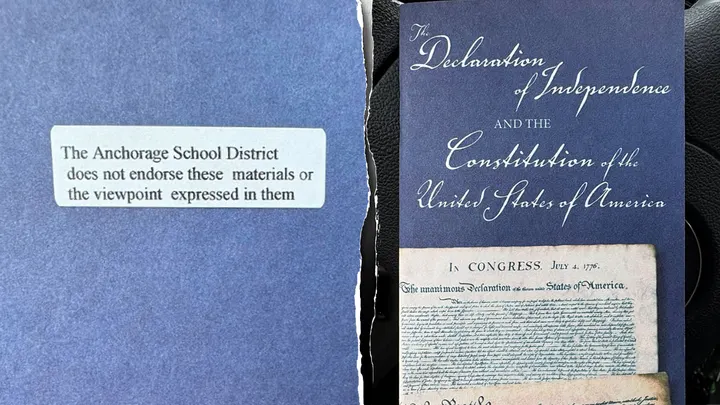
We currently turn our gaze toward a startling administrative paradox emerging from the Anchorage School District in Alaska, where the machinery of bureaucratic procedure recently collided with the bedrock of American jurisprudence. In an incident that defies both historical literacy and common sense, the district affixed a disclaimer to pamphlets containing the U.S. Constitution and the Declaration of Independence, explicitly stating that the school system “does not endorse these materials or the viewpoints expressed.” This disclaimer, a standard adhesive shield typically reserved for third-party advertisements or controversial external solicitations, was inexplicably applied to the very charters that established the legal framework within which the school district itself operates. The pamphlets, originating from Hillsdale College, were distributed to students, only to be met with the bewildered scrutiny of parents who found the district’s apparent disavowal of the nation’s founding texts to be legally and educationally incoherent.
The repercussions of this error rippled immediately through the community, prompting a swift rebuke from legal authorities and concerned citizens alike. Karen Waldron, a parent who intercepted the materials, publicly questioned why a public educational institution would feel compelled to distance itself from the foundational principles of the republic, characterizing the documents as non-controversial pillars of student learning rather than partisan literature requiring a warning label. The situation escalated to the desk of Alaska Attorney General Stephen J. Cox, who condemned the district’s actions as “deeply concerning.” Cox articulated a sentiment shared by many constitutional scholars: that treating the Declaration of Independence and the Constitution as suspect external viewpoints invites dangerous confusion regarding their role as the supreme law of the land and the source of the government’s own legitimacy.
Facing this acute backlash, the Anchorage School District has since retreated, classifying the incident as a procedural “mistake” rather than an intentional ideological statement. M.J. Thim, a spokesperson for the district, acknowledged that the materials were erroneously routed through a processing system designed for external vendor requests—a bureaucratic autopilot that indiscriminately stamped the non-endorsement clause onto the pamphlets. The district has pledged to review its internal protocols to prevent such a conflation in the future, asserting that these founding documents are, in fact, integral to their curriculum and reflective of the values they intend to instill. We at Constitution Watchdog remain vigilant, noting that while this specific error may have been administrative, it underscores a pervasive fragility in how institutions handle and present the intellectual genealogy of American rights.